How modern living in London is changing the way people form relationships

How modern living in London is changing the way people form relationships

Modern living in London is reshaping how people connect by encouraging more intentional, lifestyle-driven interactions.

London is a city of over 9 million people where being alone is surprisingly easy. Not alone in a physical sense – because the trains are full and the streets are always busy – but alone in a way that reflects modern living. Many young adults live independently, often in compact flats or shared spaces, balancing long work hours and demanding routines. Over time, this lifestyle has started to influence not just how people live, but how they connect with others.

The way people form connections today is closely tied to how they experience their home environment. Living arrangements, financial pressures and daily routines are reshaping expectations around companionship, support and personal interaction.

The impact of urban living on daily life

London offers opportunity, but it also comes with a fast pace and high cost of living. Many residents spend a significant portion of their income on rent, often choosing smaller homes or shared accommodation. Long commutes and extended working hours leave limited time for social interaction.

In this context, the city can feel isolating in ways that smaller places are not. In smaller towns, social circles tend to overlap more naturally through community spaces and slower lifestyles. In London, maintaining connections often requires deliberate effort, planning and time – resources that are already stretched.

As a result, people are becoming more selective about how they spend their time and with whom they choose to share it.

Changing expectations around companionship

Modern living has influenced what people expect from companionship. Stability, clarity and shared understanding are becoming more important than traditional structures. Many individuals are no longer following a fixed path when it comes to building connections.

This shift has led some to explore alternative platforms where expectations are clearer from the beginning. For example, some individuals turn to a sugar daddy website in the UK as a way to connect with someone who offers not only companionship but also guidance and stability within a structured arrangement.

While this may not reflect everyone’s approach, it highlights a broader trend: people are increasingly looking for clarity and purpose in how they form connections, rather than relying on undefined or open-ended interactions.

The role of the home environment in connection

Where and how people live plays a major role in shaping their social experiences. Small apartments, shared housing and limited personal space can influence how often people host, socialise or build connections within their living environment.

At the same time, the home has become more than just a place to rest. It’s now a workspace, a social space and a personal retreat. This shift has made people more conscious of how their environment affects their well-being and their ability to connect with others.

As living spaces evolve, so do the ways people create meaningful interactions within them.

Traditional structures are shifting

Long-term societal changes are also playing a role. Research from Civitas suggests that marriage will functionally disappear in the country by 2062, reflecting a gradual move away from traditional frameworks. At the same time, official statistics show that fewer adults are part of legally recognised partnerships than in previous decades.

These changes do not indicate that people no longer value connection. Instead, they show that individuals are exploring different ways of forming meaningful bonds that better fit their current lifestyles.

In a city like London, where flexibility is often necessary, people are adapting their expectations to suit their circumstances.

Lifestyle, ambition and personal growth

London attracts individuals who are ambitious and career-focused. For many, personal growth and professional development take priority during their early adult years. This focus can influence how people approach companionship, often leading them to seek connections that align with their goals and lifestyle.

In some cases, this includes connections that offer mentorship, shared ambition or guidance. These dynamics are not entirely new, but they are becoming more visible as people look for meaningful ways to integrate connection into a busy, goal-driven life.

A more intentional way of living

What stands out most is a shift toward intentional living. People are making more conscious decisions about where they live, how they spend their time and who they allow into their lives.

London’s environment – fast-paced, expensive and demanding – encourages this level of awareness. Instead of following traditional expectations, individuals are choosing paths that feel practical and aligned with their personal circumstances.

This includes rethinking how they form connections, prioritising clarity and valuing quality over quantity.

Conclusion

Modern living in London is reshaping everyday life in subtle but meaningful ways. From housing choices to work routines, these factors influence how people experience connection and companionship.

While traditional structures continue to evolve, the desire for meaningful interaction remains unchanged. What has shifted is the approach – people are becoming more intentional, more selective and more aware of how their environment shapes their choices.

In a city that never slows down, finding connection is no longer about following a set path. It’s about creating one that fits the way people live today.

Frequently asked questions (FAQs)

How does living in London affect personal connections?

Living in London often involves long working hours, high living costs and smaller living spaces. These factors can limit social interaction and encourage more intentional, selective connections.

Why do people feel more isolated in large cities?

Large cities can feel overwhelming despite being crowded. The fast pace, dispersed social circles and busy lifestyles can make it harder to maintain meaningful interactions.

Are traditional relationship structures declining in the UK?

Yes, long-term trends suggest a gradual shift away from traditional structures, with projections indicating that marriage may continue to decline over time.

How does the home environment influence social life?

Living conditions, such as space, comfort and location, directly impact how often people socialise and build connections within their personal environment.

Why are people exploring alternative ways to connect?

Many individuals are seeking clarity, stability and meaningful interaction. This has led some to explore structured platforms and modern approaches that better align with their lifestyle and expectations.

[disclosure*]

Planning for your trip away to London

Arial view of London, showing Tower Bridge and the Thames

London is a great place to visit for a solo holiday, a romantic breakaway or a family trip abroad. It’s a city that offers so much; you can explore the museums, see a theatre show, dine in a myriad of award-winning restaurants, enjoy a cocktail (or two) at one of their fancy bars or simply wander the streets and soak up some of the history.

Before arriving in London, there are a few things you should get sorted. To start with, your accommodation is very important. Then there are your transfers to and from London. If you have a late flight, it may be worth using a luggage storage company so that you can explore the city one last time before you leave.

To help you with your trip to the capital of England, we’ve put together our guide on planning for your trip away to London.

Booking your accommodation

London is like many major cities in Europe and the world; it has great places to stay and not-so-great places to stay. Prior to booking any accommodation, make sure you read the reviews. Generally speaking, it’s best to stay as central as you can, saving you on travel time and costs when sightseeing.

Booking your excursions

When in London, there’s so much to see and do. You probably won’t have enough time to do everything you want to do, but to avoid missing out, try to get your excursions booked as soon as possible. You should visit the museums as these are free and quite impressive – the science museum is great for kids! If you can, try to catch a theatre show, as London is known for its great shows. The standard tourist attractions are also worth going to, such as the London Eye, Big Ben, Madame Tussaud’s and London Dungeons.

Booking your transfers

The connections in London are quite good if you want to use the train and buses. If you arrive at Gatwick, you can get a train into central London and then get a bus, or if you arrive at Heathrow, you can get the underground to most places. The other option is to arrange a transfer to pick you up from the airport, which is good, as they’ll take you directly to your hotel. When booking transfers, try to get multiple quotes, to ensure you’re getting a good price and like mentioned above, always read reviews to ensure they’re a reputable company.

Organising your insurance

Never go on holiday without taking out travel insurance; we can’t stress enough how important it is! It covers you for any medical emergency, as well as your luggage and flight delays and cancellations. Travel insurance isn’t expensive, and you can buy year-long ones, if you have further holidays planned. If you’re unlucky and become ill, have an accident or have important or valuable items lost or stolen, it could be a long and costly experience if you don’t have the right cover for your breakaway.

Booking your extras

There are many little extras that you can add to your holiday. You could start your holiday in style and book an airport lounge. When in London, you could book an upgrade for your hotel or a package, such as a birthday package if you’re celebrating one. You may also need to organise extras such as luggage storage if you’re leaving late at the end of your trip – this way you don’t have to carry your luggage around with you all day.

As you can see, there’s plenty to think about before visiting. Our biggest advice would be to organise as much as you can as far in advance as you can. The sooner you have things booked, the less likely you are to forget things, and it could also save you some money, especially booking flights in advance.

You’ll have a great time in London, that’s for sure! Where are you planning on staying when you visit? Are you planning on doing anything that you think our readers should also consider? Is there anything missing in our guide that you think we should add? Let us know in the comment box below, we look forward to hearing from you.

[disclosure*]

Auction Alert: Fine Auction

Pair of gilt metal palm trees

This week’s featured Auction Alert is Lots Road Auctions‘ – Fine Auction. They’re based in the upmarket borough of Chelsea in London. The sale takes place on 3rd January 2022 from 11am.

Lots Road may be familiar to many, there’s been a really insightful television series, “The Auction House” (2 series so far, in fact) about the organisation that follows the whole selling process. You’ll find the very first episode, in its entirety, at the the bottom of this post.

There’s a total of 600 lots in the sale, including modern fine art, tribal art, furniture, lighting and china. The estimates given seem pretty steep; perhaps that’s due to the fact that it’s central London prices. However, you can walk away with an original (print) Picasso, Matisse, Antony Gormley or Alexander Calder or  for less than a grand!

There’s an added 3% + VAT (3.6% including VAT) surcharge added on all successful autobids & live bids through their website. You can also bid via the easylive auction website, and either pay a flat fee of £3.00 or 3% of the final hammer price.

Here’s their ‘blink and you’ll miss it’ video whirl through all the lots up for grabs on the 3rd. Beneath that, is the dozen or so that we’ve selected to feature.

"Portrait de Mme Z", Picasso

Lot 82: PABLO PICASSO ‘Portrait de Mme Z’, 1943
On silk, ref: Spadem, 76cm x 72.5cm, framed and glazed.
Estimate: £800 – £1,000

Matisse 'Nu Bleu III'

Lot 92: HENRI MATISSE ‘Nu Bleu III’
Original lithograph from the 1954 edition after Matisse’s cut-outs, printed by Atelier Mourlot, suite: ‘The Last Works’, signed and dated in the plate, 33.5cm x 36.5cm, in Montparnasse frame.
Estimate: £800 – £1,000

Desk chair

Lot 152: REVOLVING DESK CHAIR
Charles and Ray Eames inspired, ribbed leather, revolving and reclining on an adjustable base with castors.
Estimate: £800 – £1,200

Ercol daybed

Lot 314: ATTRIBUTED TO ERCOL SURFBOARD SOFA
210cm W.
Estimate: £800 – £1,200

Serge Mouille style floor lamp

Lot 359: SERGE MOUILLE STYLE FLOOR LAMP
213cm H.
Estimate: £200 – £400

Glass apple and pear

Lot 372: OVERSIZED GLASS APPLE AND PEAR
Murano style hand blown glass, approx 40cm H (2)
Estimate: £150 – £250

Drinks trolley

Lot 468: DRINKS TROLLEY, 1960s
French style, gilt metal and glass, 81cm x 84cm x 36cm.
Estimate: £280 – £380

3 cocktail trays

Lot 488: COCKTAIL TRAYS
A set of three, 40cm x 25cm, black and gold Art Deco style. (3)
Estimate: £180 – £280

Pair of gilt metal palm trees

Lot 506: MAISON JANSEN STYLE PALM TREES
A pair, gilt metal, 95cm H. (2)
Estimate: £250 – £350

Entrance hall mirror

Lot 519: ENTRANCE HALL MIRROR
54cm x 67cm x 36cm, including coat racks along base and rack above.
Estimate: £280 – £380

Cloud floor lamp

Lot 568: FEATHER CLOUD FLOOR LAMP
Gilt metal tripod feathered shade, 168cm x 60cm x 60cm.
Estimate: £280 – £380

Collection of convex mirrors

Lot 578: CONVEX MIRRORS
Ten, gilt frames, various sizes, 26cm diam at largest. (10)
Estimate: £250 – £350

Wine cooler

Lot 592: WINE COOLER POLISHED METAL
32cm x 31cm x 20cm, stamped with various wine houses.
Estimate: £300 – £400

Creative Collections: Door Knockers

Wreath door knocker | H is for Home

We talked about our day wandering around Spitalfields recently – in particular, all the fabulous original architectural features that we saw – many dating from the 18th & 19th century.

Lion's head door knocker | H is for Home Lion's head door knocker | H is for Home

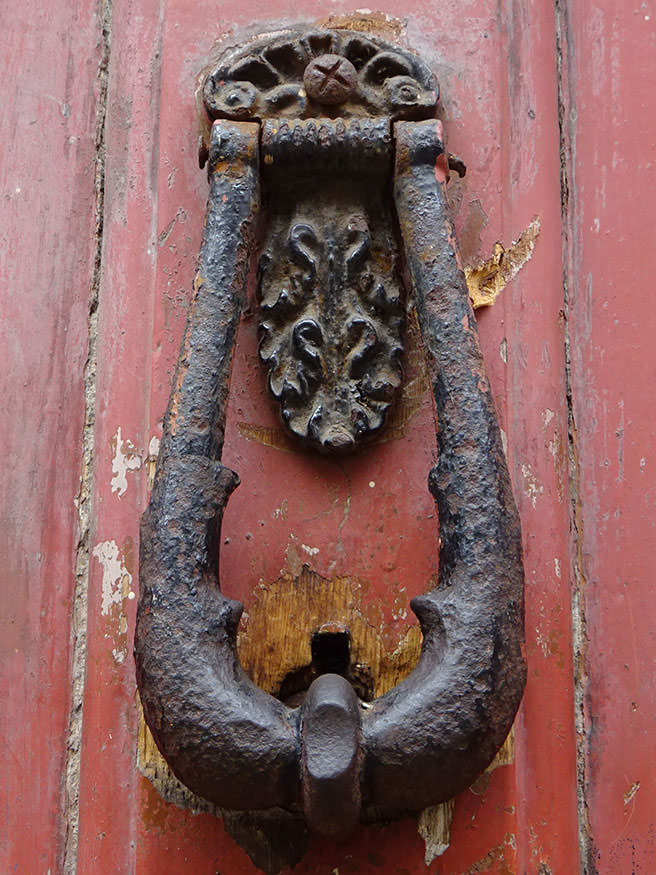
One such feature was the door knockers. We became aware of them immediately. They came in all shapes, sizes and styles – with some common themes such as garlands, rope twists, ladies’ hands, sphinx heads, fish and lions.

U-shaped door knocker | H is for Home

Door knockers are thought to have originated in ancient Greece, when… wait for it… a slave was chained to the door. Their sole purpose was to open the door for recognised visitors. If they’d fallen asleep, the metal ring that they were chained to acted as a knocker to wake them up. We’re pleased to announce that no one was chained to the doors of Spitalfield! Ancient Rome adopted the custom and door knockers became a feature of wealthy houses throughout the empire. Over time, they developed from a simple ring into the more elaborate designs.

Sphinx's head door knocker | H is for Home Sphinx's head door knocker | H is for Home

Think of all the people who’ve knocked on them over the years – from tradespeople delivering & hawking their wares to dinner guests in their finery. Imagine all the characters and costumes! That’s the wonder of historical objects. And there are fascinating little historical side stories to be uncovered. For example, the design below is early Georgian and known as the ‘Doctor’s door knocker’ as it actually indicated where a doctor lived. It has now become one of the more commonly reproduced classic examples seen throughout the UK.

S-shaped door knocker | H is for Home

Adelle was given an antique lion’s head door knocker many years ago by her dad to put on the front door of her first ever flat – and it’s been mounted on every front door of every house lived in since. The lion represents bravery, valour, nobility and strength. It’s seen as a protective force for those living within the house. Alas, it doesn’t seem to put off cold callers or the delivery of bills.

Ladies hand door knocker | H is for Home Ladies hand door knocker | H is for Home

We saw lots of these lovely hand knockers that day. They’re based on the hand of Fatima – a palm-shaped amulet that protected against evil. It was seen as the perfect form for a door knocker, protecting the house inhabitants in the same way. They were common in countries around the Mediterranean, from where their popularity spread. Fatima is also known as Hamsa – the daughter of the prophet Muhammad – and her symbolic hand is a popular talisman across the Middle East and Northern Africa.

Ladies hand door knocker | H is for Home

An attractive door knocker has such presence – and makes a very good first impression on visitors.And when you wander round historical streets like those in Spitalfields, with different knockers on every door, it adds such interest to the rows of houses. These pictures represent only a small selection of those we saw that day. If we ever return to the area (which we’re sure that we will), we’re going to create a more comprehensive image catalogue.