


There are some building jobs around the house that, without the proper skill, knowledge or equipment really shouldn’t be embarked upon; major electric jobs and servicing a boiler are two such tasks.
Putting down laminate flooring can be a DIY job, even if you’re not the most experienced or confident individual. The tips in our beginner’s guide to laying a laminate floor will help you get the job done quickly, easily and with the minimum of stress and a top quality finish.

Choose
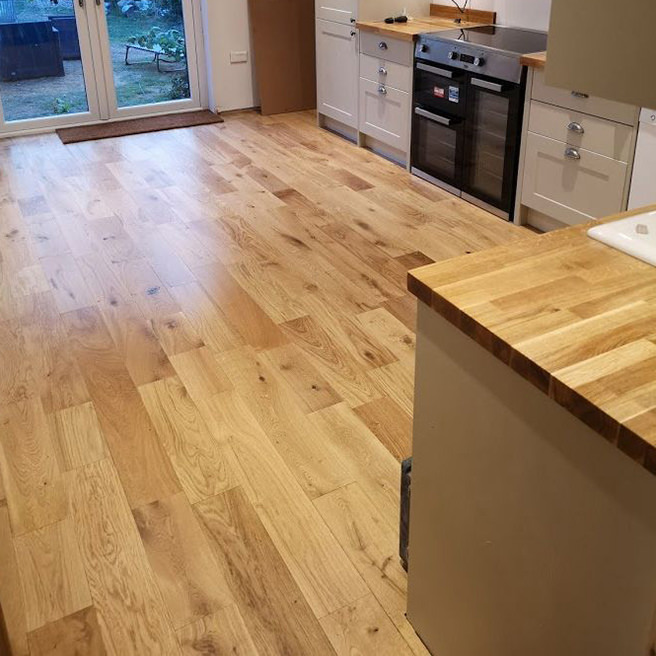
In which room will you be laying the laminate floor? It’s suitable for almost any room except for a bathroom as it isn’t a completely waterproof option. If you’re after quality, opt for engineered wood flooring which is durable and hard-wearing as it’s manufactured using a top layer of real wood. This makes it the perfect material for heavy traffic areas such as porches and hallways. Laminate is a hygienic option as it’s easy to clean; a quick sweep or vacuum and then a going over with a damp mop. Therefore, it’s a good choice for the kitchen, laundry or children’s nursery.
Laminate flooring is available in click lok or tongue & groove boards which simplifies the fitting process. It’s available in a huge array of wood finishes with attractive natural knots and graining. Depending on your décor, you could choose rustic oak, sleek American black walnut or natural maple.

Measure
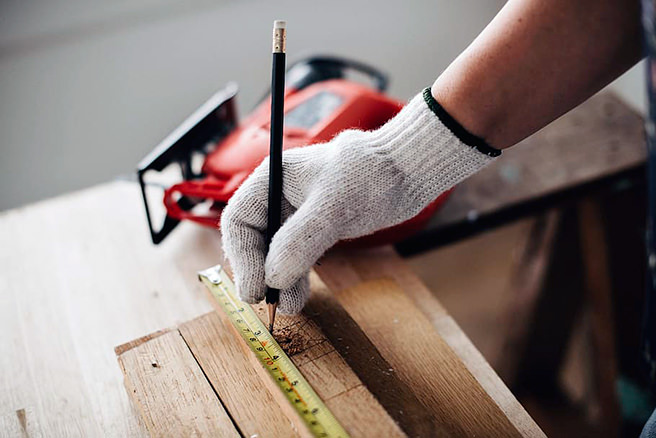
As the old adage goes, ‘Measure twice, cut once’. You don’t want to waste time, money and materials by cutting the boards too short or at the wrong angle. Saying that, it’s always best to order a little more than you think you actually need in case things go a bit wrong.


Cut
Once your chosen flooring has been delivered, give it at least 24 hours indoors to allow it to acclimatise (preferably inside the room in which it’s to be laid) before you begin cutting it. The wood will expand or contract and adjust to the temperature and humidity of your home.
Ensure you have the necessary tools to hand before you begin the job. A workmate bench will make the task a lot easier – especially if you’re working on your own. You’ll need a hand hacksaw or electric jigsaw to cut the boards quickly, cleanly and precisely. Also, a hammer and small block of wood to gently tap and close any gaps between the boards as they’re being laid. You’ll need a few spacers to put between the wall and planks. This ensures a uniform gap around the edges which allows the floor a little give to expand in hot or humid conditions.
Also, although not absolutely necessary, some people like to glue the edges of laminate flooring to prevent movement. Finally, a mitre box would be useful for making angled cuts for boards that will be positioned in the corners.

Lay
Before you begin laying, ensure you’ve swept or vacuumed the base that the laminate will be laid upon and that it’s completely dry.
If the base is made of levelled concrete or ceramic tile, ensure you put a layer of plastic sheeting between it and the laminate to act as a waterproof membrane. If the base consists of wooden floorboards, make sure the boards are nailed in securely and lay underlay on top of it before the laminate goes down. Laminate is also suitable for laying over underfloor heating and even carpet, so long as the surface is even.
It’s favourable to lay the laminate boards so that the long sides are parallel to the lengthiest wall in the room. Also, stagger the position of boards to ensure their edges don’t all line up uniformly. This is for strength as well as attractiveness.

Finish
For a professional, high-quality finish along the edges of walls and over door thresholds, it’s recommended that you lay skirting boards, beading, trims and/or cover strips.
Once the flooring job is complete, we recommend that you refrain from walking on it for 24 hours as it may affect the evenness of the surface.
[disclosure*]