Iden seek!

Three pieces of vintage Iden pottery | H is for Home

We love a bit of Iden Pottery – the subtle colours, interesting patterns and tactile surfaces. You may need to be a bit selective however, some of the early hand made studio ware is gorgeous.

Vintage Iden Pottery lamp base | H is for Home

We bought this fabulous lamp base a while ago, but still haven’t married it up with a suitable shade. We’ve been keeping an eye out for a cream or beige Hessian shade but alas, nothing of the right size or shape has appeared on our travels. We need to make a more determined effort – perhaps an internet trawl is required. It’s such a shame to leave this lovely piece languishing in a storage box.

Detail from vintage Iden Pottery mug | H is for Home Detail from vintage Iden Pottery lamp base | H is for Home Detail from vintage Iden Pottery vase | H is for Home

Iden Pottery was founded by Dennis Townsend when he left Rye Pottery in 1959. The wares were sold by Harrod’s and Heal’s and are well regarded for their quality of design and finish. Their pared back subtlety means that they don’t scream at you from a distance – so keep your eyes peeled for hidden gems on flea market stalls or charity shop shelves.

Vintage Iden Pottery base stamp | H is for Home

Larger objects such as the lamp base work well as stand alone pieces in a variety of interior styles. We like grouping smaller pieces in groups alongside other pieces of Iden – or as part of a general collection of studio pottery from the same era.

Designer Desire: George Cook

Mosaic of George Cook pottery items for Ambleside Pottery

Earlier this week, we wrote about a piece of Ambleside pottery we bought. Today we’re going to show you a few more examples of work by its maker, George Cook. Cook was the founder and main designer-maker of Ambleside Pottery based in the southern Lake District, Cumbria. He ran the pottery from 1948 until he retired in 1968, when he sold the premises to Brian Jackson. Between 1959 & 1966, he trained Gordon Fox who currently owns & runs Kentmere Pottery.

George Cook pieces regularly come up for sale at auctions across the UK and occasionally appear on eBay. They’re very reasonably priced… for the time being!

The 1954 Rydal Women’s Institute programme reveals how the group held their April meeting at George Cook’s studio. A pottery demonstration formed part of the event. The studio was located in North Road, in an abandoned corn mill (see bottom photo taken in April 1886) by Stock Ghyll, Ambleside. The pottery remained in existence until the 1980s. At present, it operates as the Giggling Goose Café. Apparently, examples of the pottery can still be found on the roof above the kitchen window.

George Cook, founder of Ambleside Potterycredit

Stock Ghyll Mill, North Road, Amblesidecredit

Additional image credits: Worthpoint

Dish of the day: Ambleside Pottery

Vintage Ambleside Pottery slipware dish | H is for Home

We don’t go into charity shops that much any more, but we had a mooch in a couple yesterday – after viewing the auction at Hartley’s in Ilkley (a nice town for a day out if you’ve never been – auction, independent shops, cafes etc). We made a few purchases including this cute little vintage slipware dish.

Detail from a Blue slipware pottery dish produced by Ambleside Pottery | H is for Home

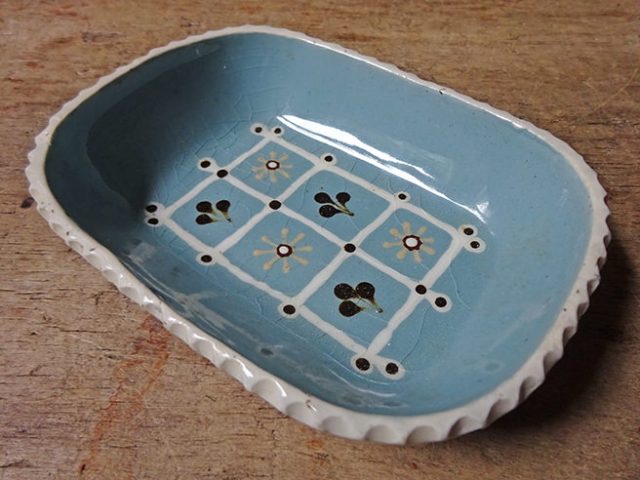
It was made at Ambleside Pottery which was founded by George Cook in the late 1940s. This is quite an early example and rather charming, we think. They also produced some fabulous sgraffito designs which have real mid century modern style.

Stamp detail from a Blue slipware pottery dish produced by Ambleside Pottery | H is for Home

The pottery closed in the 1980s. It’s developing a wider following of collectors, but is still very affordable. Strangely we saw the best piece of Ambleside Pottery we’ve ever come across in Ilkley – a huge 1950s flagon-like slipware jug. It was for sale at the aforementioned auction. We couldn’t attend on bidding day, so left a bid. Alas, we didn’t leave one high enough, missed out – and have regretted it ever since!

Designer Desire: Alan Wallwork

Mosaic of Alan Wallwork studio pottery | H is for Home

Last week, we wrote about a vintage Bernard Rooke pottery floor lamp that we acquired recently. We also mentioned that he, at one time, shared a studio in Forest Hill and then Greenwich, London with fellow potter and Goldsmiths graduate, Alan Wallwork.

Wallwork (born 1931) is best known for his beautiful, often colourful, glazed tiles that adorn tabletops, cheeseboards, trivets etc. He also produces the most sensuous, sculptural studio pottery pieces. Often inspired by nature, these textural works resemble acorns, seed pods, eggs, slices of fruit, shells and fossils.

His art pottery pieces can often be found for sale at auction houses all around the country. The tiled items are very affordable and are always available on eBay and Etsy.

Alan Wallwork at work in his studiocredit

Additional imaged credits:

1stDibs | Invaluable