Cakes & Bakes: Roman bread

'Cakes & Bakes' blog post banner

Salad & cold meat platter with Roman bread

I had about 250g of wholegrain spelt flour languishing in the store cupboard for months. There wasn’t really enough of it to make anything by itself so I combined it with some plain, strong bread flour to make a version of Roman bread.
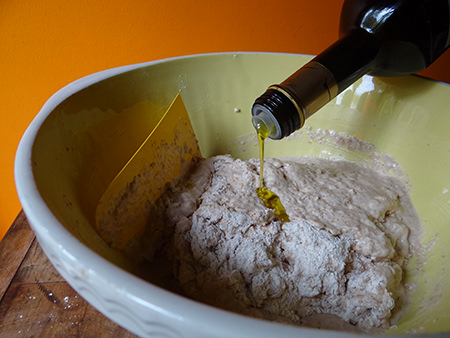
Adding olive oil to Roman bread dough

Roman bread – as you may guess – is apparently a recipe found in the Apicius – an 4th century cookbook. It’s a simple, rustic loaf consisting of spelt flour, water, yeast, honey and olive oil.
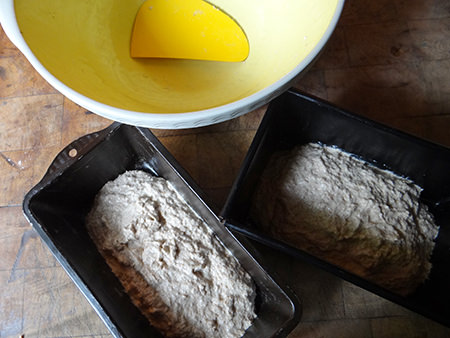
Roman bread dough in loaf tins

Spelt is an ancient grain that would have been common at the time the Apicus was written. It fell out of favour in the 19th century but, mainly because of its lower gluten content, it’s growing in popularity once more.
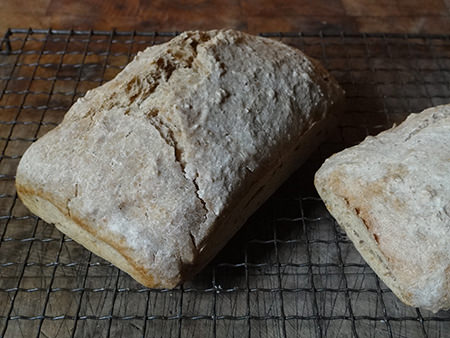
Two Roman bread loaves

Spelt dough requires more liquid, but doesn’t need to be kneaded or proved for as long as regular wheat flour – which is an advantage if you’re pushed for time!

Base of Roman bread loaves

I would have thought that the yeast originally used would have been of the wild variety, made using grape must.
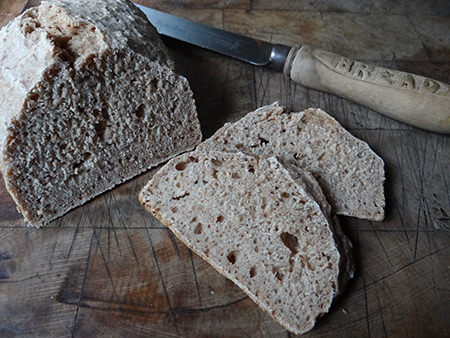
Loaf of Roman bread, sliced

I may attempt to make an ‘authentic’ Roman bread soon – using a pre-ferment, 100% spelt flour and will form the loaf into a traditional round rather than use a tin. I’ll let you know how it turns out!

Salad & cold meat platter with Roman bread

Roman bread

Doves Farm
Cook Time 45 minutes
Course Bread
Cuisine Italian

Ingredients
  

  • 250 g wholegrain spelt flour
  • 250 g strong bread flour
  • ½ tsp salt
  • 1 tsp quick yeast
  • 1 tbsp honey
  • 400 ml warm water
  • 1 tbsp olive oil

Instructions
 

  • Preheat the oven to 200ºC/fan 180ºC/400ºF/Gas mark 6
  • In a large mixing bowl, combine the flour, salt and quick yeast
  • Dissolve the honey in the water and roughly mix it into the flour
  • While the dough is still craggy add the oil and mix well
  • Knead or work the dough for a few minutes then divide between two 500g/1lb bread tins
  • Cover and leave to rise in a warm place for about 25 minutes
  • Bake in a pre-heated oven for 40-45 minutes
Roman bread ingredients
Keyword bread, yeasted bread

Cakes & Bakes: Spelt cereal loaf

'Cakes & Bakes' blog post banner

Home-made spelt cereal loaf | H is for Home #realbread #bread #loaf #spelt #baking #recipe

I must confess, I have a soft spot for a Warburton’s Toastie. I love that first, fresh crust slice with just a thin scraping of butter (only Lurpak will do!). A couple of soft white slices from a ‘bought that day’ loaf, spread with some crunchy peanut butter and half a sliced banana… divine!

This spelt cereal loaf – I borrowed a recipe from Country Bread by Linda Collister & Anthony Blake – is a much more healthy option than most loaves of bread you’d buy in the supermarket. Spelt flour has more protein and a little less calories than regular wheat flour. The added oats, bran, wheatgerm and sunflower seeds crank the nutritional value up to the max.

Justin enjoyed a few slices today with a bit of pate. I fancy a cheese & Branston pickle doorstop!

Here are a few other ideas of how to use spelt flour in your baking!

Spelt cereal loaf

Ingredients
  

  • 250 g white bread flour
  • 250 g spelt flour
  • 100 g rolled oats
  • 75 g malt flakes
  • 50 g wheatgerm
  • 25 g sunflower seeds
  • 15 g sea salt
  • 15 g fresh or 7g dried yeast
  • 400 ml lukewarm water
  • 2 tsp olive oil
  •  
  •  

Instructions
 

  • In a large mixing bowl, mix the flours with the cereals, seeds and salt
  • Make a well in the centre
  • Put the yeast into a measuring jug and make into a smooth liquid with a little of the water and pour into the well in the flour
  • Add the olive oil and remainder of the water
  • Gradually work the dry mixture into the liquid to make a soft, slightly sticky dough - it should not stick to the bowl or your fingers, so add a little more water if necessary
  • Turn out onto a floured work surface and knead well for 10 minutes
  • Return the dough to the bowl and cover with a damp tea towel or put the bowl into a large plastic bag and close tightly
  • Leave to prove at room temperature until the dough has doubled in size - about 2 hours
  • Knock back the risen dough with your knuckles to deflate it, then turn out onto a work surface
  • Pat out into a rectangle the length of your banneton or greased tin before putting it into the container
  • Cover and leave to rise again until almost double in size - 1-1½ hours
  • Towards the end of the rising time, preheat the oven to 220ºC/425ºF/Gas mark 7
  • Uncover the dough (if using a banneton, carefully tip the dough out on to a greased baking sheet) and bake for 35 minutes until it turns golden brown and sounds hollow when tapped on the bottom of the loaf
  • Cool on a wire rack for at least half an hour before slicing & serving