

What makes that perfect coffee break? Well designed machines to brew it in…


Striking pots to serve it from…


Beautiful cups to drink it out of…


And not forgetting… cosies to keep it warm!


Coffee time @ H is for Home
What makes that perfect coffee break? Well designed machines to brew it in…
Striking pots to serve it from…
Beautiful cups to drink it out of…
And not forgetting… cosies to keep it warm!
Coffee time @ H is for Home


This is the beautiful, stylised and very desirable fruit & leaf design of the Eden range designed by Marianne Westman for Rorstrand of Sweden in the 1960s. This apple pattern was used to decorate various pieces of oven and tableware.


We have this lovely, lidded sauce boat from the range available in the H is for Home web shop
It can be used for sauces, compotes, relishes… and is gorgeous enough to simply keep on display!

Whether it be the physical landscape itself or the flora & fauna contained within it, artists and designers have been influenced by nature over the centuries.
Inspiration drawn from mountains, rivers, lakes, seas, clouds, trees, birds, fish, plants, flowers are all reflected in their work.
We thought it would be fun to take these broad themes and show their influence on the creative process. For no particular reason, we’re going to start with something fishy!


vintage 1960s pottery plates

We might feature stuff from any decade, but there will, no doubt, be a mid 20th century bias as we love this era and are always drawn to vintage pieces from the 50s, 60s & 70s.

Large 1950s green glass dish


1960s art glass sculptures
Stylised fish were a much-used design motif in this mid 20th century period – in art, design and everyday homewares.
 Collage entitled Fish Fossil Sea Bed by Andrew Rob, 1970


1960s iron trivet | Swedish serving dish (Dukat)


Aquarius series fish plates by Washington Pottery


John Clappison, Hornsea Pottery | Bernard Moss Pentewan Pottery

Hornsea Pottery wall-mountable fish… who needs flying ducks?
Also, the artistic treatment given in cookbooks etc can be quite magical. Two of our undoubted favourites are Bill Charmatz and Charley Harper.


Bill Charmatz – from the Esquire Cook Book first published in Great Britain in 1956.
 Charley Harper – from Betty Crocker’s Dinner for Two first published in 1958.


Finally, to show that nature can do a pretty good job herself, we picked up this fossil from a great little shop in Hastings. Preserved in green river shales, it’s 45 million years old (hopefully you won’t be waiting that long for the launch of our website!).
 Knightia alta, Eocene period. Origin: Wyoming

We recently posted a photograph of two lava glazed vases on our Flickr page which has proved very popular. So we thought that we’d write a few words and share a few more photos about West German ceramics from the 1950s to the 1970s.
After a period of time being generally ‘out of fashion’ these amazing ceramics are being appreciated once more for their style and eccentricity. They are now regularly seen gracing the pages of design and interior magazines. The range of colours, shapes, textures and sizes is mind-boggling!

Some pieces are hand-thrown, others are mass-produced, stock shapes. However, as with the Poole Delphis Pottery range, even these stock shapes can be transformed by the textures and the individual glazes in every colour imaginable. Pieces range in size from 3 inches to well over 20 inches tall for the larger floor vases.

Impressed ‘thumbnail’ detailing

Frothing lava glaze

Incised decoration

No rules with colour combinations!
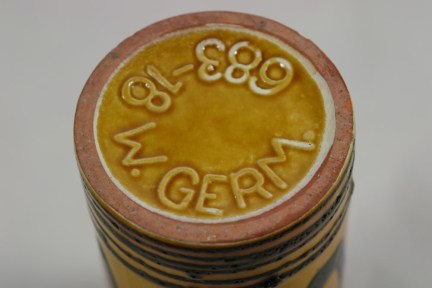
Typical base markings
A number of factories produced these characteristic ceramics – Baykeramik, Carstens, Dumler & Breiden, Jopeko, Roth, Ruscha and Scheurich to name but a few. Much has still to be learned about which company produced what. Some factories produced pieces with distinctive base markings such as the crossed swords of Dumler & Breiden, however the majority of pieces simply have serial number markings (often accompanied by ‘German’ or ‘W. Germany’). You may be lucky enough to find a piece with the original paper label, otherwise you’re in for a bit of detective work. 
There hasn’t been a great deal published on West German ceramics from this period, however Fat Lava, by Mark Hill (from Amazon UK) is a good starting point – it outlines the main factories and is packed with good quality colour photos.
In fact, the book was written to accompany an exhibition of German pottery from this period held at King’s Lynn Arts Centre in 2006.
Another place to find out more is the GinFor’s Odditiques website. Also Outernational, fat-lava.com and An Seta Pottery.
The pots work well displayed in groups of either similar or contrasting colours. The larger floor vases look great as stand-alone pieces.
Our particular favourites are the fiery oranges and reds, particularly ones with the bubbling lava glazes. We’ve built up quite a collection but good examples are getting harder to find and prices are rising steadily.

Trio of small, red and brown West German vases, 4-6 inches tall

Trio of incised vases – classic 1950s shapes

Blue vase with original Scheurich paper label

Huge floor vases

Fat lave glazes provide striking accent colours
We hope you’ve enjoyed looking at some of our collection. Have a look at our West German Pottery Collectors group on Flickr to see some more examples from us and other members. If this post has inspired you to start your own collection, then happy hunting!
Vintage West German pottery & ceramics currently available at our H is for Home online shop


Copyright © 2007-2026 · All rights reserved · H is for Home