A day out to Cors Caron National Nature Reserve

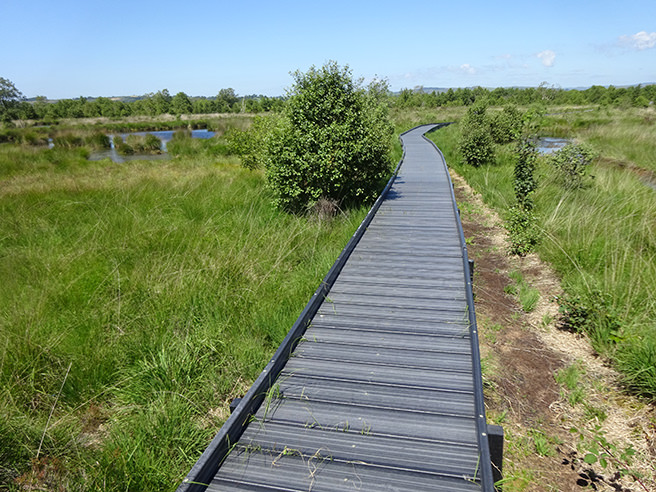
Cors Caron raised bog boardwalk in early July 2019

We took a trip to Ceredigion in Wales last week – we think that’s our 4th visit in the last 12 months.

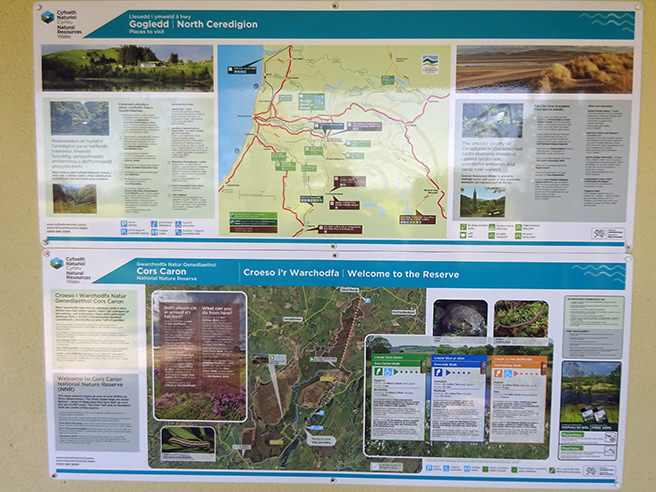
Cors Caron information board

We love the variety of walking on offer in the area – woodland, farmland, riversides and coastal scenery are all within easy reach.

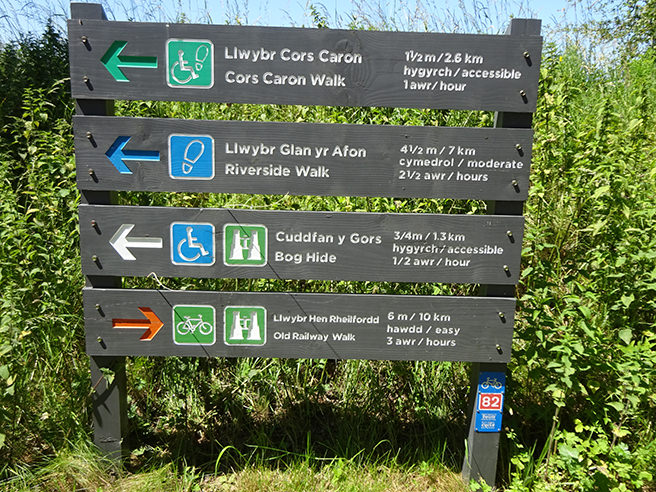
Wooden signage showing different walks at Cors Caron

One rather special and rare habitat that we visited was to be found at Cors Caron National Nature Reserve. It’s a large, open expanse of ancient peat bog – with various footpaths, gravel tracks and raised ‘decking’ walkways to explore. It covers an area of approximately 2,000 acres in total. The raised bogs built up from deep layers of peat have taken around 12,000 years to form.

Cors Caron raised bog boardwalk in early July 2019

This was the first time that we’ve actually visited the site in mid-summer – and really beautiful it was too.

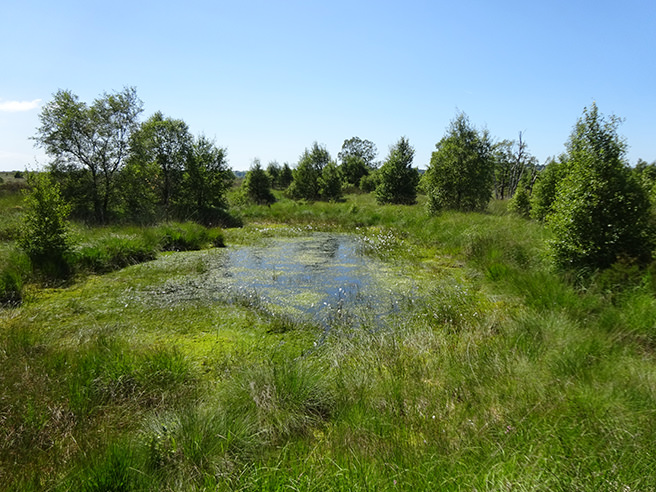
Raised bog

It was green and lush with huge, clear blue skies above.

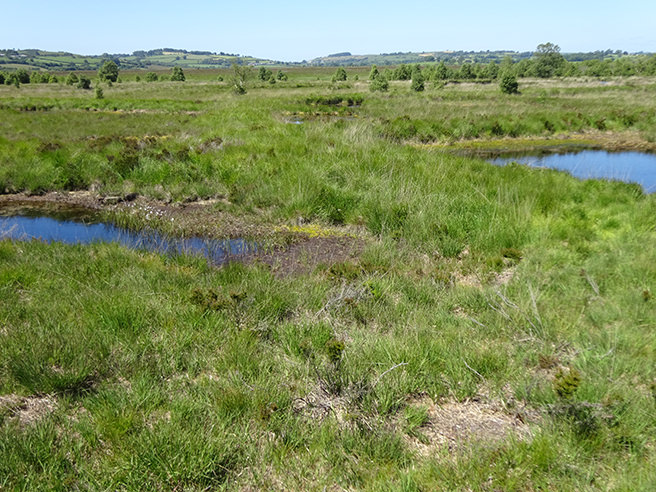
Raised bog

We strolled slowly around the reserve taking in the scenery and wildlife. Bees, butterflies, dragonflies, damselflies and all manner of other insects flitted and buzzed around. An incredible 170 bird species have been recorded here and you could here various songs and calls as you walked. We particularly loved the sound of the curlew that drifted across the site. We didn’t see any otters on this visit, but apparently they do roam these waterways – along with other mammals such as water voles and polecats.

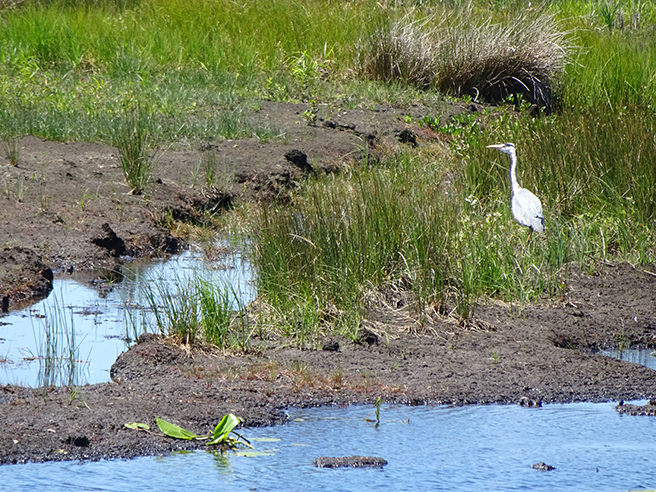
Heron in a raised bog

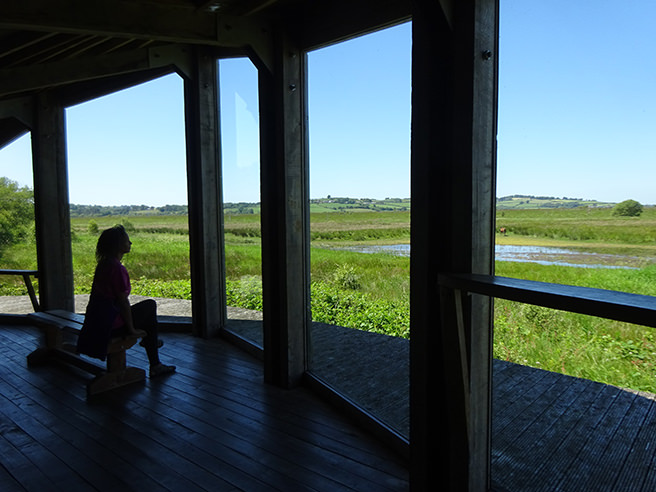
We stopped for a moment at the hide – what a view! From inside the dark, enclosed hide – the outside seems to stretch out in Techni-colour before you.

Hide along the Cors Caron raised bog boardwalk

The Cors Caron reserve is also home to many interesting, and sometimes rare, wild flower species such as the bog asphodel (pictured below), cotton grass and sphagnum moss.

Yellow bog asphodel growing in a raised bog

If you’re ever in the area be sure to stop and take a wander. There are walks of varying distances on offer, you’ll come across wonderful sights on all of them.

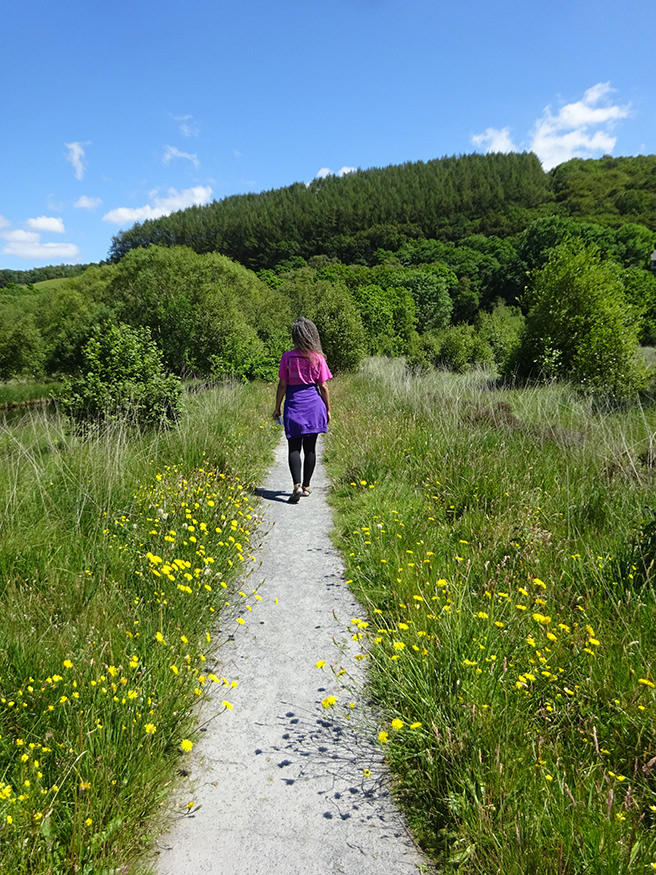
Wildflower path

It’s an uplifting, life affirming place. Hopefully we’ll return very soon!

Wildflower path

If you click on the panoramic image above, you can see it in greater detail. Additionally, if you’re planning a visit, you can download a PDF copy of the map here.

Trinidad beaches: A trip around the coastline

Trinidad Beaches: a trip around the coastline | H is for Home

This is the second in my roving reports from Trinidad. Last time, I checked out the street food on offer. This week, I’m taking a trip around the island visiting popular and less well known Trinidad beaches.

During the 3 weeks that I was over there, I was lucky enough to go to Chaguaramas, Maracas, Las Cuevas and Mayaro – only a tiny proportion of the beaches the country has to offer. I reached out to a bunch of old school friends and my aunt, who was visiting at the same time, for images of the rest of the coastline. The response was overwhelming so I’ve managed to assemble a fabulous collection of photos – over a hundred… it was a true group effort!

You’ll grasp the varied history of the island from the diverse names of the places that I mention. Trinidad – with its indigenous Amerindian people – was colonised by the French, Spanish and finally, the British.

I’ve put the photographs into some semblance of order, beginning at Maracas in the north and travelling clockwise around the coast. There are even a couple of short film clips to add some extra island flavour!

Maracas

Probably the most popular beach in Trinidad – especially at the weekend. There’s a huge car park, changing facilities and plenty of food and drinks places. Deckchairs can be hired and there are safety flags and lifeguards on duty.

Tyrico

A little, almost hidden away, beach between Maracas and Las Cuevas. Because of this, it’s always more chilled and less crowded. The sea water is also calmer in this spot; therefore suitable for children and less confident swimmers.

Tyrico Beach, Trinidad © Coleen Power

Las Cuevas

Las Cuevas (Spanish for ‘The Caves’) was a lot more developed than the last time I’d visited; granted, that was way back in the 1980s sometime. There’s now a large car park, changing rooms and lifeguards. We visited midweek – so there were few people there. We stayed about 3 hours, leaving around 2pm. One thing I remember from the 80s though, the sandflies come out in force at sundown – I doubt that’s changed – bring your insect repellent if you’re visiting later in the day.

Blanchisseuse

The name derives from the French for ‘washerwoman’. You access Blanchisseuse either via the North Coast Road or driving north from Arima via a twisting & turning road which passes the Asa Wright Nature Centre, a destination I highly recommend. Head for L’Anse Martin Bay to the West, Marianne Beach and River to the East and 3 Pools and Avocat Waterfall an inland hike from the river.

Grande Riviere

The Grande Riviere river empties out into Grande Riviere Bay. The beach is renowned for the huge leather-back turtles that return year after year to lay their eggs in the sand. Because of this spectacular natural phenomenon, the area has developed into an eco-tourism destination.

Grande Riviere, river © Celeste Chariandy

Toco

Toco is the most north-easterly place in Trinidad and the closest point to sister island, Tobago. It’s a popular spot with surfers, being the windy, rocky confluence of the Caribbean Sea and the Atlantic Ocean. At the end of the road stands Galera Point Lighthouse.

Manzanilla

I filmed a few seconds our journey to Mayaro through the rear windscreen of the minibus on our way to our trip to Shangri-la Vacation Home. Mile upon mile of coconut tree-lined road hugging the Atlantic shore, in parts, a few narrow (and, at times, perilous) feet away.

Manzanilla, as I said, is located along the Atlantic coast. The sea can be rough and choppy with dangerous currents – especially at high tide.

Mayaro

The coast of Manzanilla meets Mayaro at the bump that is Point Radix, the location of the spectacular 300-acre Ben Deloraine Nature Reserve. I’m not going to lie, I went all the way down to Mayaro with family but didn’t go near the beach or the sea; I stayed liming round the Shangri-La pool.

The main reason was because of the sargassum. It’s not as serious as it was last year, but it’s still piled up along the tide line and floats around in the sea. Another justification for me not embarking on the less than 5-minute walk to the beach wasn’t because I was lazy. No, it’s because I was stung by a man o’war jellyfish as a child in the sea at Mayaro; an experience I’ll never forget. But don’t let me put you off – Mayaro is a beautiful place!

Moruga

Moruga is a small fishing community with a number of claims to fame. It is said to be the spot where Christopher Columbus landed when he ‘discovered’ Trinidad. The La Ruffin Bridge at Moruga is the only suspension bridge in use in Trinidad. It was originally built to transport the cocoa from the nearby plantations to market. Its maintenance was lacking – and local fishermen used it to moor their boats – resulting, in 1993, in its collapse into the river as a van was travelling over it. Luckily, it is now on the Heritage Asset Register. The town is home to the Trinidad Moruga scorpion – the 2nd-hottest chilli in the world.

Icacos

Icacos is the most south-westerly point of Trinidad and therefore the polar opposite of Toco. It’s a calm peninsula of sandy beach bordered by a parade of coconut trees, a stone’s throw across the Gulf of Paria from Venezuela. Head for Columbus Bay where you’ll spot the Three Sisters rock formations out at sea.

Port of Spain

The sea around the capital city isn’t necessarily a place to go for a swim. Rather, it’s arguably one of the best places in the country to pull over in your car – perhaps with a bite to eat – to watch the stunning sunsets this part of the coast enjoys.

Chaguaramas

Chaguaramas is a stretch of coastline that lies just to the west of Port of Spain. This makes it a place where people go (especially Macqueripe), mid-week, for a ‘quick dip’ to unwind after a day at work. It’s very accessible; Western Main Road runs closely alongside. The area is where sailing types congregate; a number of boat yards and marinas exist such as Small Boats, Power Boats and the Sailing Association.

Down-the-Islands

Or ‘Dung-de-Ayelans’! Not a ‘beach’ as such – and only accessible by boat – Down-the-Islands is a little collection of mostly uninhabited islands in the Bocas (Spanish for ‘mouth.). They are touching distance from Venezuela. The islands include Monos (Spanish for ‘monkey’), Gaspar Grande, Huevos (Spanish for ‘eggs’) and Chacachacare (its original Amerindian name); the last being a former leper colony.

Here’s a visual depiction of where all the Trinidad beaches I’ve mentioned are located..

Outline map showing a number of Trinidad beaches | H is for Home
Outline map showing a number of Trinidad beaches

Trinidad street food to try when you’re there

Trinidad street food to try when you're there | H is for Home

I’ve just returned from 3 weeks in Trinidad – the place where I grew up – on a joint business and pleasure trip. When I visit the island, one of the main things I look forward to doing is indulging in the array of delicious street food that’s available.

All the images included here were taken either by me, my good friend, Simone or my aunt Coleen who was visiting at the same time – on holiday from Canada.

Doubles

Doubles are probably my favourite of all the street food you can buy in Trinidad – and they’re the messiest to eat! Doubles – an Indian dish – are two bara (hence the name ‘doubles’) with a spoonful of curry channa (chickpeas) in between. You have the option of a sprinkling of kuchela, amchar, tamarind chutney, chopped cucumber and/or pepper sauce. Ask for “no pepper”, “slight pepper” or “plenty pepper” depending on your tolerance for chilli!

Two women making doubles at the roadside on Tunapuna Road, Arima | H is for Home

Locals have them for breakfast – to set them up for the day – or in the wee hours following a late night out drinking and socialising.

Buying doubles at the roadside in doubles at the roadside on Tunapuna Road, Arima | H is for Home

Roti

Ask six people who makes the best roti and you’ll get half a dozen different answers! Roti is another Indian speciality eaten  straight out of the wrapper with the hands. It’s a soft, slightly spiced bread – similar to a tortilla – that is stuffed with curried vegetables, meat (chicken, beef, goat, lamb) or seafood (shrimp, conch) and condiments such as curry mango and pepper sauce before being folded and wrapped ready for demolishing.

A couple of the best roti places are Hosein’s on Eastern Main Road, San Juan and Hott Shoppe on Mucurapo Road, St James. The one pictured below – a dhalpuri roti filled with channa, potato and pumpkin – (which was the best one I ate on my visit) was from The Roti Café, Upper Saddle Road, Cantaro, Santa Cruz. I sat down to eat at a table outside, washing my roti down with a Carib from the Roundabout Bar next door – it doesn’t get much better than that!

There are a few different forms of roti from which to choose; the aforementioned dhalpuri, sada, parata/buss-up-shut (busted up shirt) – they’re all good!

Vegetable dhalpourie roti with a bottle of Carib lager beer | H is for Home

Ice cream

As well as doubles and roti, I was most looking forward to becoming reacquainted with B&M ice cream on Western Main Road in St James. The home-made ice cream is available in a variety of flavours – chocolate, coconut, rum & raisin, Guinness, cocopine, peanut, cherry vanilla, barbasop (barbadine and soursop) – and my own personal favourite – soursop (guanábana).

B&M ice cream vendor. Western Main Road, St James | H is for Home

Coconut water

Nothing quenches the thirst in the midday tropical heat of Trinidad like coconut water. There are half a dozen or so coconut vendors to choose from around the Savannah in Port of Spain. Back in the day, they were sold out of the back of old wooden carts. Today, the vendors have fancy chariots sporting colourful wrought ironwork and advertising boards. To find them, head for the west side of the Savannah, opposite the ‘Magnificent Seven‘. When you’ve downed the water, don’t forget to hand the coconut back to the vendor to chop it into segments so you can eat the delicious jelly.

Coconut vendors around the Savannah. Port of Spain, Trinidad | H is for Home

Snow cones

Snowcones comprise of a dome of shaved ice (about the size of a tennis ball); a few squirts of brightly coloured, sweet flavoured syrup and topped with (optional) condensed milk. To be honest, they’re not my favourite, but they’re very popular – especially with young kids!

Snowcone vendors in Trinidad | H is for Home

Gyros

Not everyone is a vegetarian like me. There’s a lot of choice for the carnivore too! The number of gyros stands has exploded in Trinidad, helped by the rise in Syrian immigrants to the country. Ariapita Avenue, or simply ‘The Avenue’, in Woodbrook/St James is Gyros Central.

Yousef Gyros on Ariapita Avenue, Woodbrook, Trinidad | H is for Home

The Avenue is where many of the capital’s popular bars are located. Often, where you find people drinking alcohol, you’ll find people who crave a kebab (the nearest UK equivalent of a gyro). It’s not just drinkers though, people stop to buy gyros on their way back from work to eat them at home.

Working the rotating spit at Yousef Gyros on Ariapita Avenue, Woodbrook, Trinidad | H is for Home

Jerk

Another meaty street food to be found in Trinidad is jerk. It arrived fairly recently from Jamaica, further up the Caribbean, and in becoming an increasingly popular choice. The meat – usually chicken – is marinaded in a jerk seasoning and cooked on a barbecue. It’s served with French fries with toppings such as BBQ sauce, tomato ketchup and the ubiquitous pepper sauce.

Jerk chicken vendor. St James, Trinidad | H is for Home

Bake and shark

Or should that be shark and bake? Whichever way you say it, it’s a must when you visit Maracas Beach. Maracas was the place my friends and I would drive to every Sunday to relax after a hectic weekend of partying.

The ‘bake’ part is a fried bread, the ‘shark’ component is self-explanatory – pan fried, seasoned shark. However, these days, other types of fish such as king fish, grouper and talapia are used as a substitute for shark – mainly due to environmental and availability reasons. The bread is topped with salads, condiments and sauces of all kinds. The bake and shark pictured below is from Uncle Sam & Sons on Maracas Beach.

Bake and shark from Uncle Sam's, Maracas Bay© Simone De Silva-Gomes

‘Lookout’ stalls

There’s a lookout on the Lady Young Road and another on the North Coast Road en route to beaches at Maracas, Las Cuevas and Blanchisseuse. They’re places to stop the car to take in the stunning, panoramic views. The former overlooks the capital city, Port of Spain and the latter, the verdant coastline tumbling into the Caribbean Sea. Both boast a couple of large food stalls that offer sweet, savoury, salted and pickled snacks and treats to peckish travellers. I especially recommend trying the pineapple chow, salt prunes, red mango, tamarind (pronounced ‘tambran’) balls and sugar cake.

Trini Treats food stall at the North Coast Road lookout | H is for Home Edens food stall at the North Coast Road lookout | H is for Home

We pulled over, bought some snacks and took a few photos on our way to Las Cuevas.

Edens food stall at the North Coast Road lookout | H is for Home Edens food stall at the North Coast Road lookout | H is for Home

Debe food strip

Simone drove me to Débé – a town in the South of Trinidad – that’s famous for it’s Indian food stalls. Indian fast food is my all-time favourite – and there’s a huge choice for vegetarians like me!

Welcome to Debe sign, Trinidad | H is for Home

Strip of food stalls in Debe, Trinidad | H is for Home Strip of food stalls in Debe, Trinidad | H is for Home Strip of food stalls in Debe, Trinidad | H is for Home

Sweet treats for sale in Debe, Trinidad | H is for Home Sweet treats for sale in Debe, Trinidad | H is for Home

Indian street food display cabinets in Debe, Trinidad | H is for Home

Selection of street food we bought in Debe, Trinidad | H is for Home

The photo above is what we bought:

1. Baiganee (aubergine) | 2. Saheena (dasheen and split peas) | 3. Kachourie (channa and/or split peas)
4. Khurma (sugar-coated flour) | 5. Aloo (potato) pie | 6. Baiganee (aubergine)
7. Doubles | 8. Ginger ale | 9. Solo Apple J

What to bring on your first camping trip

What to bring on your first camping trip | H is for Home

So, you’re booked to go camping for the first time. Maybe you’ll be travelling light, wild camping solo in the Cairngorms in Scotland. Perhaps you and your family have just bought a new 4-berth caravan to go touring around Europe for a month. You’re wondering what you do and don’t need to pack to make the experience enjoyable, memorable and relaxing. Here are some of the things that we recommend you bring with you on your first camping trip.

Purple & white cooler bag on grass

Food

I don’t know about you, but for us, a camping trip is all about al fresco dining. You won’t always be near a source of drinking water, so bottled water is a necessity. We all love cooking outdoors, so a reusable barbecue (don’t forget the matches!) and/or camping stove is top of the list. If you’re not that into cooking, make mealtimes as stress-free as possible by bringing pre-prepared or simple-to-cook things such as dried pasta and tinned food. A cool box/bag with reusable freeze boards keeps food & drink chilled for many hours.

Collapsible camping table with wicker picnic hamper, enamel mug, moka coffee maker, mugs and hurricane light

Furniture

Whether your in a single-person tent or in a huge Winnebago, you’ll probably want to spread out a bit. Erect an awning; you never know when you may want to shelter from a rain shower… or baking midday sun! A collapsible table & chairs with a parasol/umbrella are useful for mealtimes or just hanging out. When camping, a deck chair is where I like to spend a lot of my time; reading, sunbathing or just watching the world go by.

Person in the middle of woods at night shining a torch

Tools

Don’t get caught out in an unfamiliar place after dark – it’s easy to get lost on your way to and from the shower/toilet block; make sure you bring a torch/flash light (and extra batteries if needed). If you’ll be in a tent, always pack more tent pegs than you think you’ll need – they often go missing or can break… and remember a mallet for securing them into the ground!

Person walking in muddy walking boots

Clothing

The clothes you’ll need will depend on where you’re going camping. If you’re holidaying in the UK, the changeable British weather means you’ll probably need some waterproofs. If you’re planning on exploring the countryside, comfortable walking boots and/or walking sandals are a must. If you’re visiting somewhere hot, don’t forget to pack your flip-flops, sun hat/cap and swimwear.

Blue & red zip up first aid kit

First aid

The great outdoors is a fun and adventurous place however, it can throw up a few hazards. Make sure you compile a little first aid kit that includes plasters, insect repellent, anti-histamine cream, disinfectant cream, sun screen and pain killers.

Boy and a girl paddling in a yellow kayak

Games

You’ll need to get involved in activities that don’t encroach on other campers. Camp sites can be busy, crowded places; bring along a totem tennis set instead of a football, rugby ball or cricket set. These are likely to stray, crashing into neighbouring tents and nearby vehicles. If there’s a lake, sea or river where you’ll be camping, a canoe, kayak or inflatable dingy would be great – especially for the kids. Carry board games and a pack of cards to bring out in the evenings to while away hours of darkness.

We don’t suggest that you’ll need all of what we set out above, every camping trip is different. However a couple of them are vital; the food, the water, the first aid items. What are some of your camping essentials?

[disclosure*]