The journey of Buddha statues: From Asia to your home

The journey of Buddha statues: From Asia to your home

Few symbols globally capture such a sense of peace, meaning and deep spirituality as the figure of Buddha. It transcends religious and geographical boundaries, becoming a universal symbol of calmness, mindfulness and personal balance. Whether placed in a tranquil temple courtyard or a modern living room, the Buddha’s serene presence encourages reflection and fosters a feeling of tranquility.

Yet, every Buddha statue carries with it a remarkable story, one that begins in the ancient temples of Asia and finds its way into homes all over the world. This isn’t merely a tale of craftsmanship; it’s a journey through faith, culture and the connections that bring us together.

The origins: Where Buddha statues are born

The art of sculpting Buddha statues dates back over two thousand years, right around the time Buddhism began to spread across Asia. Initially, the Buddha was depicted in a more symbolic manner, using elements like footprints, trees or wheels to convey his essence. However, as time went on, sculptors began to create more relatable depictions of his figure, which helped his followers connect with his teachings on a deeper level.

Countries such as Thailand, Myanmar, Nepal, India and Sri Lanka emerged as hubs of spiritual creativity. Every area brought its unique flair, shaped by regional beliefs and artistic heritage.

In Thailand, statues frequently exhibit refined features and graceful gestures that embody compassion. The designs of Myanmar reflect a deep sense of devotion and elegance, characterised by intricate details and gentle smiles. Nepalese artisans, especially those from the Newar community, have honed their skills in metal casting, producing intricate bronze and gilt statues that exude a sense of sacred energy. Each statue embodies the essence of its region, intertwining artistic brilliance with a deep sense of spiritual reverence.

The artisans behind the work

Crafting a Buddha statue transcends mere industrial methods; it embodies a profound spiritual practice. Numerous artisans approach their craft as a form of meditation, chanting mantras as they shape, carve and perfect every detail.

The journey typically starts with selecting the appropriate material. Bronze stands out as a favoured choice, celebrated for its enduring strength and classic shine. Both wood and stone hold a special place for their natural warmth and solid, reassuring presence. Some artisans skilfully combine materials, incorporating gold leaf or semi-precious stones to further deepen the symbolic significance.

Every detail is intentional. The gentle curve of the lips conveys a sense of compassion, while the closed eyes signify a state of enlightenment and the lotus pedestal embodies the purity that emerges from the fleeting nature of existence. As the last brushstroke or polish is applied, the artist takes a moment to bow, recognising that the piece is now both finished and revered.

The selection process: From Asia to the world

Delivering genuine Buddha statues to collectors and spiritual sanctuaries around the globe is truly a journey marked by dedication and reverence. Businesses like Original Buddhas invest years in carefully sourcing items directly from temples, monasteries and reputable artisans throughout Asia.

Representatives frequently journey to distant areas to connect with artisans, guaranteeing that each statue embodies genuine authenticity and integrity. They work hand in hand with local communities to safeguard traditional methods while ensuring fair and ethical trade practices.

This careful selection process ensures that every statue is not merely a beautiful object but a true representation of Asian spirituality. Bringing one home means acquiring not just a piece of art, but a fragment of living history, meticulously crafted over centuries of passion and dedication.

Authentic vs. replicas: Understanding the difference

In the current market, one can find a range of both genuine and replica Buddha statues, each differing greatly in significance, artistry and the energy they convey.

Genuine statues are either vintage or crafted by hand employing time-honoured casting or carving methods. They frequently display minor flaws, delicate inconsistencies that emphasise their genuine nature and personal craftsmanship. In contrast, replicas are created en masse using moulds and machinery. Although they may catch the eye, they fall short in terms of depth, aura and the rich cultural significance found in hand-crafted creations.

The selection of materials is significant as well. Genuine creations are made from durable, organic materials such as bronze, wood or stone. These materials mature elegantly, developing a rich patina and texture that enhance their allure as time goes by. Replicas, typically crafted from resin or composite materials, may initially appear similar but rarely possess the same durability or emotional resonance.

Opting for authenticity transcends mere aesthetic choice; it embodies a commitment to respecting history and tradition.

Integrating Buddha statues into modern interiors

In modern interior design, Buddha statues serve as a connection between sophistication and serenity. They bring a serene vibe to environments, enhancing them with cultural depth and visual harmony.

Creating a Zen-inspired interior

A Buddha statue effortlessly enhances minimalist and zen-inspired environments. Envision a space adorned with light wood furnishings, soft hues and a warm, inviting glow of natural light, an ideal backdrop for reflection. Positioning the statue on an elevated surface like a low table, pedestal or recessed niche enables it to capture attention while maintaining a harmonious balance within the space.

The aim is to achieve balance. In Zen philosophy, each component is meant to foster tranquillity. The Buddha stands as a quiet reminder, encouraging you to pause and take a breath amid the everyday hustle.

Designing a meditation corner

For individuals engaged in meditation or mindfulness, adding a Buddha statue can elevate the ambiance of the environment. Utilising it as a visual anchor sharpens focus and fosters a sense of ritual consistency. Incorporate cushions, plush textiles and the warm glow of candles and watch as the area evolves into a personal haven, an oasis for serene contemplation.

Numerous practitioners choose to light incense prior to meditation, representing the cleansing of both mind and spirit. In this environment, the statue transcends mere decoration; it becomes a steadfast ally in your pursuit of understanding.

Balancing energy through feng shui

In feng shui, the Buddha symbolises abundance, peace and the movement of positive energy.  The positioning is crucial.  A statue at the entrance invites positive energy into the home, while another in the living room fosters harmony among family members.

When oriented towards the east, a direction associated with enlightenment, the Buddha represents renewal and spiritual awakening.  Respect is paramount: always keep it elevated and away from disorganised spaces.  A pristine and elevated environment fosters a more favourable energy flow.

The spiritual meaning behind Buddha statues

Each Buddha statue narrates a unique tale. The way it stands, moves and expresses itself is rich with meaning that goes beyond the boundaries of time and culture.

Understanding mudras

The word ‘mudra’ denotes the symbolic hand gestures found in Buddhist art. Every one imparts a unique spiritual insight:

  • Dhyana mudra – hands gently placed in the lap, thumbs meeting, embodying a sense of meditation and equilibrium.
  • Abhaya mudra – hand lifted with palm facing outward, symbolising courage and safeguarding.
  • Bhumisparsha mudra – One hand resting on the earth, evoking the instant when the Buddha reached enlightenment.

The gestures direct the observer toward particular virtues, tranquillity, empathy or enlightenment and shape the ambiance of the statue’s surroundings.

The power of expression

Facial expressions convey significance as well. A soft smile reveals a sense of contentment; slightly closed eyes suggest deep thought; an upright stance signifies both resilience and awareness. The nuance of these expressions is deliberate, encouraging the viewer to reflect their own feelings and discover a connection within.

A Buddha statue serves as a reflection of the soul, reminding us that true peace resides within ourselves, rather than in the external world.

Why choose authentic Buddha statues?

Selecting a genuine statue is a thoughtful choice to embrace art that embodies both elegance and authenticity. In a time characterised by rapid manufacturing and throwaway aesthetics, genuine Buddha statues emerge as enduring gems, deeply anchored in artisanal skill.

They embody three timeless values:

  • Durability and longevity – crafted from timeless materials, these statues mature beautifully, evolving into cherished family heirlooms that transcend generations.
  • Cultural preservation – every item champions artisans dedicated to preserving traditional craftsmanship, safeguarding a rich heritage that has stood the test of time.
  • Spiritual authenticity – genuine artistry embodies a deep sense of awareness and commitment. Genuine statues exude a serene energy that imitations simply cannot match.

Embracing authenticity allows you to weave history and spirituality into your living space, all while championing ethical and sustainable craftsmanship.

The journey’s end: From temple to home

When a genuine statue finally arrives at your home, its journey comes to an end, but its narrative lives on through you. Whether situated in a cosy reading corner, a serene garden or a sleek urban apartment, it elevates the environment into a realm of contemplation and balance.

For some, it serves as a gentle nudge to embrace mindfulness each day. For some, it stands as a masterpiece representing elegance and harmony. The presence of a Buddha statue enhances both the visual appeal and emotional health, transcending personal beliefs.

Caring for your Buddha statue

Maintaining the authenticity of your statue is crucial, particularly for vintage or artisanal creations. Carefully dust with a soft cloth, steering clear of direct sunlight to preserve intricate details and refrain from using any harsh cleaning agents. Whether crafted from bronze or wood, a periodic touch-up with natural oils keeps its lustre intact and helps avoid any cracking.

Above all, handle it with the utmost respect. In Buddhist culture, nurturing the statue symbolises nurturing your own inner tranquillity.

The modern appeal: Mindfulness meets design

The current resurgence in mindfulness and sustainability has sparked a renewed fascination with Buddhist art. Homeowners and designers appreciate Buddha statues not just as decorative pieces but as symbols of mindful living.

Their presence harmonises beautifully with sustainable interiors, environments that highlight minimalism, organic materials and well-being. This fusion of spirituality and design signifies a broader cultural transformation: a transition from excess to genuine authenticity.

FAQs about Buddha statues and home integration

  1. What materials are most common for authentic Buddha statues?

Bronze, stone and wood stand out as classic choices, celebrated for their lasting strength and rich meanings.

  1. How can I verify the authenticity of a statue?

Seek out indications of artisanal creation, the charm of age and a rich history. Esteemed sellers like Original Buddhas offer certificates along with comprehensive histories of origin.

  1. Is it disrespectful to place a Buddha statue at home if I’m not Buddhist?

Not at all. When presented with reverence, it embodies fundamental ideals such as harmony and empathy, going beyond religious boundaries.

  1. Where should I place a Buddha statue for good energy?

Optimal spots include tidy, raised areas like meditation corners, living rooms or entryways, always avoiding direct placement on the floor or near disarray.

  1. How do Buddha mudras influence energy?

Every gesture conveys a unique form of uplifting energy, whether it be through meditation, courage or insight, influencing the spiritual ambiance of the space.

  1. Why are antique statues so valuable?

Their historical significance, meticulous craftsmanship and scarcity render them not only spiritually enriching but also a wise investment as time progresses.

  1. Can modern décor styles include Buddha statues?

Absolutely. Contemporary and minimalist homes frequently showcase Buddha sculptures, serving as sophisticated focal points that blend design with a sense of calm.

The living spirit of the Buddha in your home

The Buddha statue embarks on a timeless journey, from revered temples in Asia to serene residences across the globe, embodying messages of peace, mindfulness and compassion. Each creation narrates a tale that embodies not only craftsmanship but also a deep commitment to thought and reflection.

Welcoming one into your space means you become part of its narrative. You embrace calmness amidst the hustle, insight into everyday practices and elegance that goes beyond fleeting styles.

In the serene company of the Buddha, environments seem to lift, emotions find balance and consciousness expands. This ancient art offers a remarkable connection, linking cultural heritage with awareness, bridging the timeless traditions of Asia and the contemporary home in pursuit of peace.

[disclosure*]

Great Northern Contemporary Craft Fair ’11

"Great Northern Contemporary Craft Fair '11" blog post banner

Ken Eardley ceramic jugs and spoons on display

The Great Northern Contemporary Craft Fair 2011 is being held this weekend in Manchester city centre – we went to the preview night on Thursday.

a selection of Ken Eardley ceramics on display shelves

It was great to see designer-makers whose work we’ve long admired – there was also the thrill of seeing fresh, new exhibitors.

a selection of Ken Eardley ceramics on display shelves with a recent article about him in BBC Homes & Antiques magazine open on a table

We featured Ken Eardley, whose ceramics are shown above in last year’s GNCCF blog post – once again, his stand had real impact. Things are going really well for him with magazine features such as this recent one in BBC Homes & Antiques.

a display of Jane Blease's handcrafted wooden artworks, lampshades and jewellery

Another striking space belonged to Jane Blease who works primarily with bentwood & reclaimed plastic often with her characteristic hand worked thread detailing. A recent artist residency in India has clearly inspired some of Jane’s new pieces. It’s interesting charting artists’ new developments & influences.

a display of Jane Blease's handcrafted wooden jewellery

The Radiance stand belonging to Hannah Nunn always delivers the goods – her hand cut paper light shades look great when displayed en masse…

a display of Hannah Nunn's Radiance mini lamps

…and we loved her new seed pod window hangings.

detail of the display of Hannah Nunn's Radiance newly designed seedpod window/wall hanging a display of Hannah Nunn's Radiance newly designed seedpod window/wall hanging

Ruth Green, who we’ve seen at GNCCF in previous years, also had some lovely new works…

display of Ruth Green's limited edition framed prints

…and she’s also branched out into illustrated books, notebooks & note cards.

display of Ruth Green's limited edition prints, posters and illustrated books & notebooks

With autumn setting in, Andrea Lord’s &made display offered some warm seasonal comforts…

display of &Made's cream coloured hand knitted mug cosy with grey felt cushion in the background

…such as these gorgeous cushions & cosies.

display of &Made's yellow ochre hand knitted tea cosies

As we mentioned earlier, it’s really exciting to discover new makers and their work…

Gemma Truman's seagrass & glass works inspired by weaverbirds' nests

…we’ll highlight just a couple who made an impact on us.

The first was Gemma Truman, whose hand-blown glass & seagrass hangings and vases are absolutely exquisite – they’re inspired by South African weaverbird nests. We also thought they were very reminiscent of those old fashioned glass fishing net floats.

detail from Gemma Truman's seagrass & glass works inspired by weaverbirds' nests

Second was Louise Hibbert.

display of Louise Hibbert's wooden salt & pepper mills

Her pieces have a natural feel and use subtle, earthy, yet striking colours.

display of Louise Hibbert's wooden salt & pepper mills

As you can see from her salt & pepper mills, they’re organic, tactile and oh so beautiful – they just cry out to be picked up, handled and caressed.

display of Louise Hibbert's coloured wooden salt & pepper mills

The show runs till this Sunday, so visit if you can! We’ve only featured homewares in this post, but there’s also lots of jewellery and fashion on display… and all of it’s for sale… so go on, get your Christmas shopping done early!

Great Northern Contemporary Craft Fair 2010

Great Northern Contemporary Craft Fair 2010 blog post banner

collection of postcards and business cards from artists & craftspeople exhibiting at Great Norther Contemporary Craft Fair 2010

We spent Friday evening at the Great Northern Contemporary Craft Fair in Spinningfields, Manchester city centre…

handmade enamelled copper nature-inspired figures by Janine Partington who exhibited at Great Northern Contemporary Craft Fair 2010

…and a very pleasant evening it was too.

colourful handbuilt functional ceramics with hand cut stencil decoration by Ken Eardley who exhibited at Great Northern Contemporary Craft Fair 2010

The fair expanded into two pavilions for its second year.

colourful handmade screen prints, etchings and lino cuts by Ruth Green who exhibited at Great Northern Contemporary Craft Fair 2010

A great mix of ceramics, glass, metal, paper and textiles… from both new exhibitors and favourites from last year.

collection of slipware pottery by Hannah McAndrew who exhibited at Great Northern Contemporary Craft Fair 2010

There were so many great stalls – we’ve just selected a few that caught our eye.

We’ll start with Jane Blease Design.

handmade bent plywood and threaded cotton lamps and artwork by Jane Blease Design who exhibited at Great Northern Contemporary Craft Fair 2010

She uses plywood and threaded cotton to produce artworks, light shades and jewellery.

detail from a handmade bent plywood and threaded cotton lampshade by Jane Blease Design who exhibited at Great Northern Contemporary Craft Fair 2010

It’s striking from a distance, then fascinating in the detail.

handmade bent plywood and threaded cotton jewellery by Jane Blease Design who exhibited at Great Northern Contemporary Craft Fair 2010

A piece of Jane’s work was temptation number one and we’d only been in the marquee for a few seconds!

Moving along to &made,

cushions and cacti-shaped pin cushion from &made who exhibited at Great Norther Contemporary Craft Fair 2010

Andrea Lord produces lovely hand-sewn pieces…

cushions and cacti-shaped pin cushion from &made who exhibited at Great Northern Contemporary Craft Fair 2010

…her items simply & beautifully displayed.

cushions and cacti-shaped pin cushion from &made who exhibited at Great Northern Contemporary Craft Fair 2010cushions and cacti-shaped pin cushion from &made who exhibited at Great Norther Contemporary Craft Fair 2010

Cushions, wall hangings and rows of gorgeous cacti pin cushions in their little terracotta pots!

cushion and cacti-shaped pin cushions in terra cotta pots from &made who exhibited at Great Northern Contemporary Craft Fair 2010

We mentioned Derek Wilson Ceramics in our post from last year’s fair.

handthrown functional porcelain tableware by Derek Wilson who exhibited at Great Northern Contemporary Craft Fair 2010

His stand, filled with his beautiful and delicate porcelain, stopped us in our tracks again…

handthrown porcelain jug by Derek Wilson who exhibited at Great Northern Contemporary Craft Fair 2010

….elegant, understated simplicity.

Ruth Green Design has proved another favourite with our blog readers – and a shot of her prints always rides high in our Flickr photo viewings.

colourful handmade screen prints, etchings and lino cuts by Ruth Green who exhibited at Great Northern Contemporary Craft Fair 2010

We lingered at her stall for a good while.

colourful handmade screen prints, etchings and lino cuts by Ruth Green who exhibited at Great Northern Contemporary Craft Fair 2010

Her prints, sold in limited edition runs, look fabulous hanging all together.

colourful handmade screen prints, etchings and lino cuts by Ruth Green who exhibited at Great Northern Contemporary Craft Fair 2010

The Pear Tree, one of her  new designs, was another strong temptation!

You can always guarantee a striking display from Hannah Nunn’s Radiance Lighting

handmade laminated papercut lampshades by Hannah Nunn who exhibited at Great Northern Contemporary Craft Fair 2010

…the warm cosy glow of her beautiful, nature-inspired shades…

handmade laminated papercut lampshades by Hannah Nunn who exhibited at Great Northern Contemporary Craft Fair 2010

…the designs hand cut from paper and then laminated.

Adelle having a pit stop in the bar area at the Great Northern Contemporary Craft Fair 2010

Phew… time for a pit stop… a sit down with a glass of wine!!

First-time exhibitor Ken Eardley made the long drive up from Brighton where he has his studio.

colourful handbuilt functional ceramics with hand cut stencil decoration by Ken Eardley who exhibited at Great Northern Contemporary Craft Fair 2010

His range of striking pottery with stylised trees, flowers & leaves was a real show stopper.

colourful handbuilt functional ceramics with hand cut stencil decoration by Ken Eardley who exhibited at Great Northern Contemporary Craft Fair 2010

Functional and beautiful – always a winning combination.

colourful handbuilt functional ceramics with hand cut stencil decoration by Ken Eardley who exhibited at Great Northern Contemporary Craft Fair 2010

No doubt his work will be starring in lots of interiors magazines in the future!

The natural landscape strongly inspires & influences the work of enameller Janine Partington.

handmade enamelled copper nature-inspired figures by Janine Partington who exhibited at Great Northern Contemporary Craft Fair 2010

Trees, flowers, seed heads, birds and animals.

handmade enamelled copper nature-inspired figures by Janine Partington who exhibited at Great Northern Contemporary Craft Fair 2010

She produces enamel panels, small sculptures and jewellery.

handmade enamelled copper nature-inspired jewellery by Janine Partington who exhibited at Great Northern Contemporary Craft Fair 2010

We’d love to stroll through a magical forest of her making.

Kent-based Maxine Sutton plays with imagery of familiar everyday domestic objects and the natural world.

hand-embroidered and printed textiles by Maxine Sutton who exhibited at Great Northern Contemporary Craft Fair 2010

Incorporating them into embroidered and printed textiles to produce a range of interior products.

hand-embroidered and printed textiles by Maxine Sutton who exhibited at Great Northern Contemporary Craft Fair 2010

There were lots of eye-catching items on her stand.

hand-embroidered and printed textiles by Maxine Sutton who exhibited at Great Northern Contemporary Craft Fair 2010

We’ve got a standard lamp that would happily accommodate one of her large shades… and we just loved the coffee pot/cafetiere cosies with their Scandinavian feel.

The work of Sarra Kate is bright and effervescent – just like Sarra Kate herself!

colourful textile banners, cushions and greetings cards made from original collages by Sarra Kate who exhibited at Great Northern Contemporary Craft Fair 2010

Her stand called out to us from a long way away.

detail from a colourful textile banner made from original collage by Sarra Kate who exhibited at Great Northern Contemporary Craft Fair 2010

She starts her pieces by making colourful collages which are then laser printed onto textiles and paper…

colourful  greeting cards made from original collages by Sarra Kate who exhibited at Great Northern Contemporary Craft Fair 2010

…which go into making wall hangings, cushions and cards.

Last, but certainly not least, we have Hannah McAndrew, another of our favourites from last year.

collection of slipware pottery by Hannah McAndrew who exhibited at Great Northern Contemporary Craft Fair 2010

This is where we finally gave into temptation.

collection of slipware pottery by Hannah McAndrew who exhibited at Great Northern Contemporary Craft Fair 2010

We admired her stand last year, filled with its mediæval-inspired slipware pottery.

collection of slipware pottery by Hannah McAndrew who exhibited at Great Northern Contemporary Craft Fair 2010

This year we just had to take a few of her pieces home!

detail from slipware pottery jug by Hannah McAndrew who exhibited at Great Northern Contemporary Craft Fair 2010

We’ve concentrated on featuring homes and interiors products, but there was also lots & lots of fantastic fashion & jewellery – and if we featured any more this post would turn into a novel!

All the makers will be packing up and making their way home as we write this… so be sure to put the fair in your diary for next year!

West German Ceramics

Collection of vintage West German 'Fat Lava' pottery vases

We recently posted a photograph of two lava glazed vases on our Flickr page which has proved very popular. So we thought that we’d write a few words and share a few more photos about West German ceramics from the 1950s to the 1970s.

After a period of time being generally ‘out of fashion’ these amazing ceramics are being appreciated once more for their style and eccentricity. They are now regularly seen gracing the pages of design and interior magazines. The range of colours, shapes, textures and sizes is mind-boggling!

Collection of West German 'Fat Lava' vases

Some pieces are hand-thrown, others are mass-produced, stock shapes. However, as with the Poole Delphis Pottery range, even these stock shapes can be transformed by the textures and the individual glazes in every colour imaginable. Pieces range in size from 3 inches to well over 20 inches tall for the larger floor vases.

West German vase with impressed detailing

Impressed ‘thumbnail’ detailing

Fat lava glaze detail

Frothing lava glaze

Incised West German vase

Incised decoration

Colourful West German vase

No rules with colour combinations!

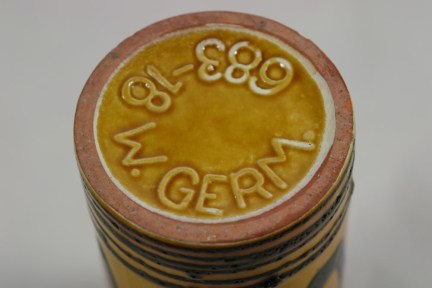
Base detail of West German vase

Typical base markings

A number of factories produced these characteristic ceramics – Baykeramik, Carstens, Dumler & Breiden, Jopeko, Roth, Ruscha and Scheurich to name but a few. Much has still to be learned about which company produced what. Some factories produced pieces with distinctive base markings such as the crossed swords of Dumler & Breiden, however the majority of pieces simply have serial number markings (often accompanied by ‘German’ or ‘W. Germany’). You may be lucky enough to find a piece with the original paper label, otherwise you’re in for a bit of detective work. Fat Lava book by Mark Hill

There hasn’t been a great deal published on West German ceramics from this period, however Fat Lava, by Mark Hill (from Amazon UK) is a good starting point – it outlines the main factories and is packed with good quality colour photos.

In fact, the book was written to accompany an exhibition of German pottery from this period held at King’s Lynn Arts Centre in 2006.

Another place to find out more is the GinFor’s Odditiques website. Also Outernational, fat-lava.com and An Seta Pottery.

The pots work well displayed in groups of either similar or contrasting colours. The larger floor vases look great as stand-alone pieces.

Our particular favourites are the fiery oranges and reds, particularly ones with the bubbling lava glazes. We’ve built up quite a collection but good examples are getting harder to find and prices are rising steadily.

Trio of West German vases

Trio of small, red and brown West German vases, 4-6 inches tall

Trio of 1950s West German vases

Trio of incised vases – classic 1950s shapes

Blue West German vase

Blue vase with original Scheurich paper label

Huge floor vases

Floral West German vase with rustic stool and knitted cushion

Fat lave glazes provide striking accent colours

We hope you’ve enjoyed looking at some of our collection. Have a look at our West German Pottery Collectors group on Flickr to see some more examples from us and other members. If this post has inspired you to start your own collection, then happy hunting!

Vintage West German pottery & ceramics currently available at our H is for Home online shop

'Fat Lava' book by Mark Hill